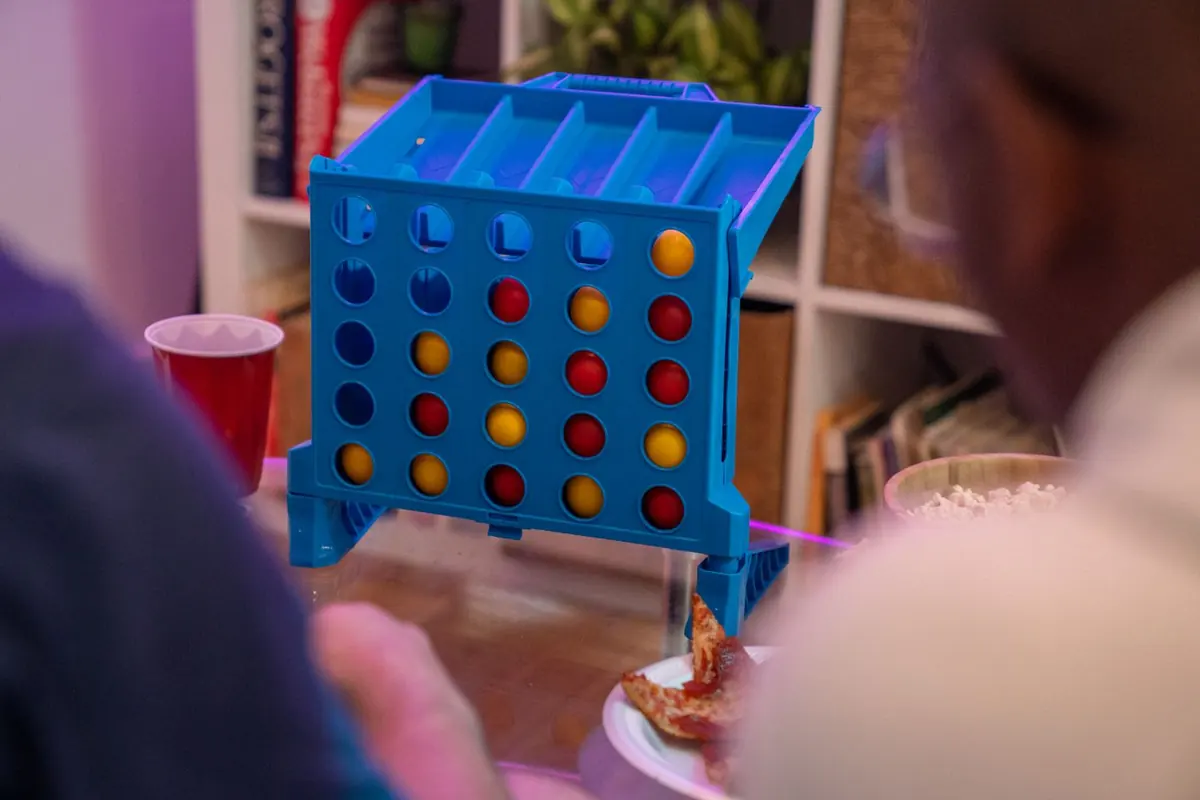
Choose conversation games for a small gathering by matching the activity to what the evening needs: an icebreaker for new acquaintances, a shared task for a mixed group, or a short competitive round for friends who already enjoy playing together. The right game does not have to be the most impressive one. It should give people a reason to talk, be easy to explain and let anyone pass without awkwardness.
When the game takes over the evening
Many hosts buy or borrow a game because it promises a lively evening, then discover that the explanation takes twenty minutes, one guest feels put on the spot and the rest of the group drifts toward their phones. The problem is rarely the game itself. It is a mismatch between the activity and the social situation. A set of personal questions that works well among close friends can feel like an interview at a dinner where people have just met. A competitive board game can produce excitement for some guests and quiet frustration for others who never had a chance to catch up.
The goal is to choose the smallest structure that gives the group something to share. For many small gatherings, that means a flexible prompt, a cooperative task or a brief round with a clear end.
Step 1: Decide what the game needs to do
Before selecting anything, name the job the game should perform. Three common jobs are:
- Break the ice: guests have just met and need low-pressure entry points.
- Fill a pause: the group is comfortable but there is a lull between courses or after a meal.
- Be the main event: the group has chosen to play together and wants a full round or session.
Each job points to a different format. An icebreaker is usually best as optional prompt cards that anyone can draw from. A pause can be filled with a question round where people answer briefly and move on. A main event needs clearer rules, a stated endpoint and enough time for everyone to take part. If people already talk easily, a bowl of optional prompts may work better than a structured round in which everyone must answer in turn.
Step 2: Choose the level of personal disclosure
The most important variable is how personal the questions are. Use a three-level check:
| Level | Typical prompt | Best for | Main risk |
|---|---|---|---|
| Light | A meal you would happily repeat; a place you like to walk | New acquaintances, mixed ages | Can feel shallow to very close friends |
| Reflective | A skill you would try for an afternoon; a book that changed your mind | Groups with some familiarity | Some guests may hesitate to share |
| Personal | Questions about relationships, money, health or family | Established friends who have chosen this | Can put guests in an uncomfortable position |
For new acquaintances, stay at the light level. Only move toward reflective prompts once the group shows it is comfortable. Avoid treating personal disclosure as proof that the activity is working. A quiet table can be a sign of a good conversation, not a failed game.
Step 3: Make passing normal from the start
Passing should cost nothing. Say before the first prompt that anyone can skip a question or choose another card, and do not ask a guest to explain why they passed. The host sets the example. If you answer your own prompt with one sentence rather than a long story, guests will usually match that level of detail. If you share something intimate and expect others to follow, you have made the game a test of openness.
Worked example: a dinner for six, three of whom have just met
Illustrative example: A host plans a dinner for six. Two couples are old friends; the other two guests are colleagues of one of the couples and have never met the rest of the group. The host considers a personal-question card deck and rejects it, since two guests are strangers to the others and personal answers could feel forced. Instead, the host chooses a set of light prompts, places them in a bowl near the dessert plates and sets the rule that anyone can draw, read aloud and answer briefly or pass. After the first two rounds, one of the colleagues offers a longer story about a childhood holiday, and the room responds warmly. The host does not push further. The game has done its job by giving people an easy way in, and the evening continues naturally without a scoring system or a required turn order.
Step 4: For mixed groups, favor shared tasks
Cooperative word, drawing or deduction games can give people something to talk about without requiring autobiographical answers. This suits groups with varied ages, backgrounds or comfort levels. Before choosing one, check the practical demands rather than relying only on the age label on the box:
- Does everyone need to read small print or follow fast spoken clues?
- Does play depend on specialist cultural references that some guests may not share?
- Does anyone need to use a phone or app to participate?
- Can the game be played at the recommended player count you usually host?
If a game excludes someone in any of these ways, choose an alternative or explain the requirement clearly before starting. Discovering after the first round that one guest cannot follow along is a common and avoidable mistake.
Step 5: Keep the first explanation short
Learn the rules before guests arrive. Set out only what the opening round requires. Explain three things: the goal, what one turn looks like and how the round ends. Play a low-stakes example instead of reading the entire rulebook aloud. Save edge cases until they come up. A game with a compact box is not necessarily quick to learn, so check the actual rules and an honest estimate of play time before committing. Keep a simpler backup activity in mind in case the explanation takes more energy than the group wants to give.
Step 6: Plan for the table you have
A game that needs a large shared surface may not work beside dinner plates and glasses. Check the size of cards, the number of components and whether pieces must stay undisturbed between rounds. For a small table, prompt cards or a spoken game are often easier than a board with individual player areas. Consider legibility: a prompt card read across a candlelit table may be hard to see. Place food and drinks where people can reach them without moving the game each time. A comfortable arrangement matters more than a beautifully styled box.
Step 7: Set an endpoint and watch the room
Set a starting limit such as one round or twenty minutes, then ask whether people want another. Do not insist on finishing a long scoring system when attention has moved elsewhere. If competition begins to dominate the atmosphere, switch to a cooperative task or return to ordinary conversation. Ending while people are still enjoying the activity is a hosting skill. Afterward, note what worked with that particular group, rather than assuming one successful evening makes the same game right for every gathering.
Common mistakes
- Choosing by reputation alone. A popular game may suit a different group size, age range or evening length.
- Making disclosure mandatory. Forced sharing usually produces polite, shallow answers.
- Explaining everything at once. Long rule introductions drain energy before play begins.
- Ignoring the physical setup. A game that does not fit the table or needs constant clearing will interrupt the flow.
- Playing to a finish no one wants. Long endings can undo a good start.
Limitations of this approach
This is practical editorial guidance based on hosting considerations, not hands-on testing of any particular game. Groups vary widely in temperament, and a format that works for one table may fall flat at another. Use the framework as a set of questions to ask yourself before the evening, and adjust based on what you observe.
Before buying a new game
Borrow a copy or read a full rules overview where one is available. Compare the recommended player count with the number you usually host, including yourself. Check whether a one-time mystery can be replayed and whether an app or online service is required. Buy for your normal evening rather than a hypothetical party. A small collection of familiar activities often creates a more relaxed gathering than a shelf of unopened games nobody has time to learn.
Questions to ask before the next gathering
- Do most guests know each other well enough for reflective or personal prompts?
- Does every guest have a reasonable way to take part without reading small print or using a phone?
- Have I set a clear endpoint, and do I know what I will switch to if the room loses interest?
Continue reading
- Small Home Upgrades for Easier Hosting: Entryway, Seating and Light
- Best Coffee Table Books for Culture, Style, and Conversation
- How to Choose a Biography or Memoir You Will Want to Finish
Cover: Pexels photograph, used as an editorial illustration. Stock models and products shown do not imply endorsement or independent product testing. Image license.