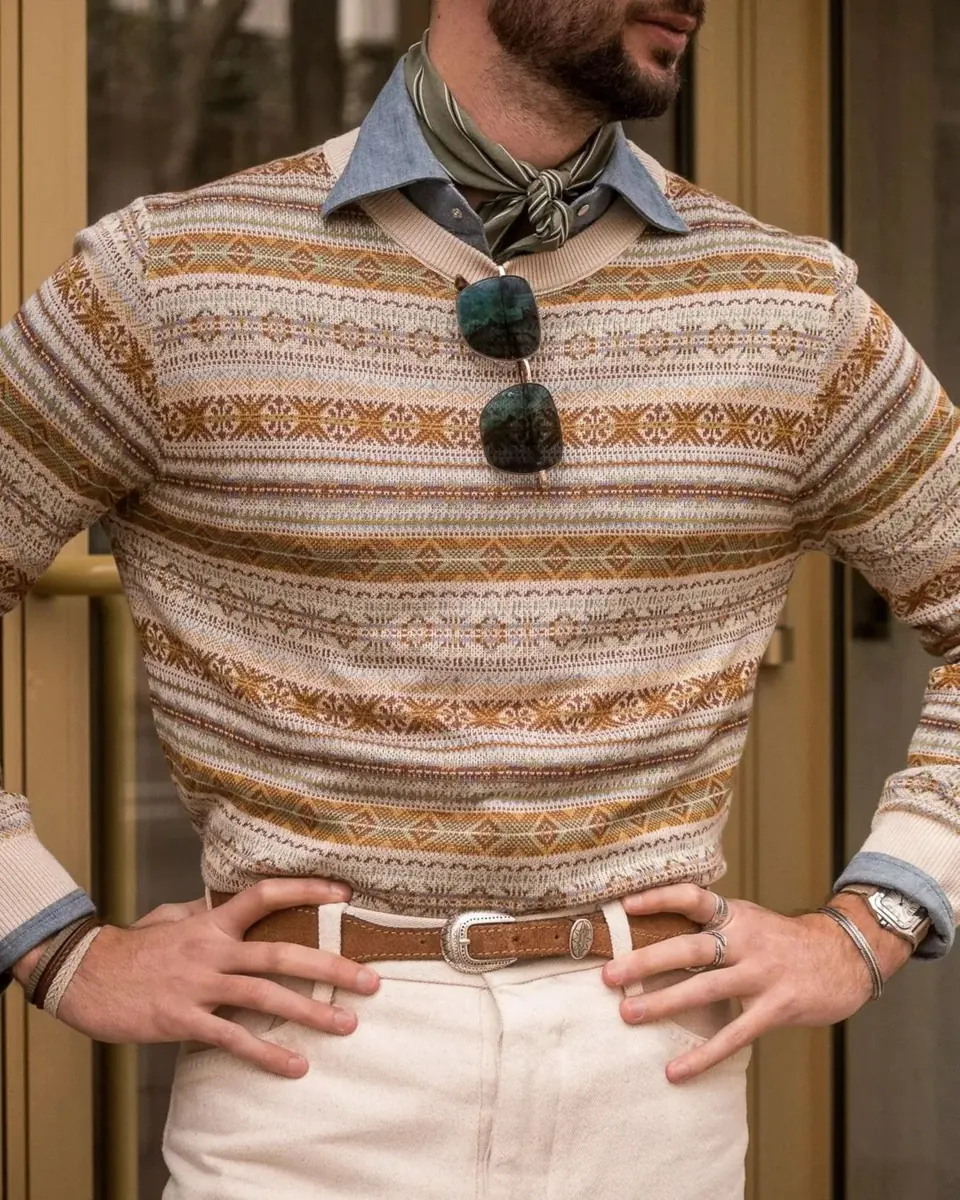
Knitwear that reads well on camera has three qualities: a texture that stays visible at small screen sizes, a neckline that frames the face without competing with it, and shoulders that keep their shape after a full day of sitting, walking and carrying a bag. A sweater that meets those three tests can move from a morning video call to a gate lounge to a casual dinner without looking like a compromise. The problem most people run into is not a lack of knitwear but a lack of criteria, so they buy by colour or by how a photo looks in a shop, then discover that the knit pills after two wears, flattens under a camera, or stretches out of shape by lunchtime.
This guide sets out a practical way to evaluate knitwear for mixed-use days. It explains how texture and gauge behave under webcam and daylight conditions, how to judge necklines and fit, how to handle care, and where the trade-offs sit. A worked example near the end shows how the same three sweaters perform across a single travel day.
Why camera conditions change the rules
Most people judge clothing in mirrors, in person, or in still photos. Video calls are different. A webcam compresses fine detail, often softens colour, and frames you from the chest up at a fixed distance. That has three practical consequences.
- Fine knits can disappear. A very dense, low-texture knit in a tone close to your background may read as a flat block of colour. A slightly chunkier stitch or a tonal rib gives the eye something to hold.
- Necklines carry the frame. Because the camera crops at the shoulders, the neckline is one of the main shapes visible on screen. A crew neck that sits too high can cut across the throat; a deep V can pull attention downward. Mid-depth necklines are the most forgiving.
- Shoulder fit matters more than usual. Sloping, puckered or drooping shoulders are visible in a head-and-shoulders frame in a way they are not in a full-length mirror.
These effects are not a reason to avoid knitwear. They are a reason to test it under the conditions you will actually use.
A three-test method for evaluating a knit
Before buying, or before deciding whether an existing sweater earns a place in your rotation, run these checks. They take about ten minutes and require only a phone camera and a window.
Test 1: The texture test
Photograph the sweater flat, then on the body, in both daylight and indoor light. Use your phone’s front camera on a regular video-call setting, and look at the image at thumbnail size. Ask whether you can still tell that it is knitted and whether the stitch reads as intentional.
- If the texture disappears into a smooth colour block, it will likely look plain on camera.
- If the texture looks busy or noisy at small size, moiré-like patterns can appear with some compression. Fine ribs and tight jacquards are the most prone to this.
- Mid-weight stitches such as moss, cable or a soft rib usually read clearly without becoming distracting.
Test 2: The neckline test
Hold the sweater at your collarbone and look at the image. Check where the neckline falls relative to your jaw and where the collar meets your skin.
- A crew neck that sits within a finger’s width of the base of the throat tends to look neat.
- A roll or funnel neck can be warm and clean on camera, but a bulky one can add visual width at the chin. Test it with your normal head position.
- A V-neck should not drop so far that it becomes the focal point of a professional frame.
Test 3: The shoulder and drape test
Sit down, lift your arms slightly as if typing, then return to a neutral posture. Look at the shoulder seam and the body of the sweater. Check whether the seam stays on the shoulder or slides down the arm, and whether the front drapes cleanly or pulls into horizontal lines.
Knits with a slightly structured shoulder and a body that falls straight tend to keep their line through a day. Very oversized styles can look relaxed in person but may read as shapeless in a head-and-shoulders frame.
Choosing materials and gauge without guesswork
Fibre content affects how a knit behaves on camera, how it wears, and how it ages. Rather than memorising brand claims, read the care label and look at the fabric itself.
| Knit characteristic | Camera result | Practical trade-off |
|---|---|---|
| Fine gauge, smooth surface | Clean, can look flat or muted | Shows pilling less, but can look thin and dated quickly |
| Medium gauge with visible stitch | Reads clearly, adds depth | Versatile for calls and travel; a good default |
| Chunky or heavily textured | Strong presence, can dominate the frame | Warm and expressive, but bulky under a jacket and harder to layer |
| High-twist or boucle yarns | Soft, busy texture | Can hide wear, but snags and sheds more readily |
For care, the most useful habit is to read the label before buying rather than after. Wool-type knits and blends often recommend gentle or hand washing and flat drying. Acrylic and polyester blends may tolerate more handling but can pill. For care specifics, follow the garment’s own label first. General background on fibre care and care symbols is available at clevercare.info, which can help you interpret labels when comparing wool and cotton knits for warmth and cleaning frequency.
A worked example: one travel day, three sweaters
The following is an illustrative example, not a test of specific products. Imagine a day that starts with a 9 a.m. video call from a hotel room, moves to a two-hour airport journey with a carry-on bag, includes a seated flight, and ends at a casual dinner.
Suppose you are choosing between three knits you already own:
- Sweater A: a fine-gauge merino-style knit in charcoal with a crew neck. Smooth and tidy, but on a grey hotel wall it nearly disappears on camera, and the crew neck sits high enough to crowd the chin.
- Sweater B: a medium-gauge moss-stitch knit in oatmeal with a mid-depth V. The texture reads clearly on screen, the neckline frames the face well, and the shoulders hold after a seated flight.
- Sweater C: a chunky cable knit with an oversized fit. It looks warm and expressive in a mirror, but on camera the cable dominates the frame and the dropped shoulder makes the upper body look rounded.
Sweater B is the strongest choice for this day because it passes all three tests. Sweater A could work for in-person meetings but needs a lighter background or a scarf to read on camera. Sweater C is better kept for casual, non-call days. The example shows that a single sweater rarely fails across the board; it fails in specific conditions, and knowing those conditions is what makes the choice easy.
Common mistakes
- Buying for the mirror only. Mirror views are long and full-length; the camera crops tightly. Always test in a frame.
- Ignoring pilling risk. Loose, fuzzy or high-twist yarns shed and pill sooner, which becomes visible in close-up lighting.
- Choosing colour that matches your wall. A sweater that blends into the background loses shape on screen. Contrast by a few tones helps more than a dramatic colour.
- Overlooking the bag test. Shoulder bags and backpacks rub the same place on a knit every trip. Fine knits show abrasion first.
- Washing without checking the label. Hot water and tumble drying can change the size and feel of a knit permanently.
Limitations of this approach
These tests are judgement aids, not guarantees. Webcam quality, lighting, and screen compression vary a great deal between people and devices, so a sweater that reads well on one setup may look different on another. The method also does not tell you how a knit will age over years of wear, which depends on yarn quality, construction, and how you store and wash it. Treat your own camera test as more reliable than any general rule.
Questions to ask before you buy
- Does the texture still read when I view it at thumbnail size on my own device?
- Does the neckline sit where I want it when I hold my normal head position?
- Can I wash and dry it the way I actually live, or will I avoid wearing it because of the care label?
- Will it still look intentional after a seated flight and a full bag strap?
Summary
Camera-friendly knitwear comes down to three things: a stitch that stays visible at small size, a neckline that frames the face without crowding it, and shoulders that hold their line through a long day. Test each one with your own camera and your normal posture, read the care label before you buy, and accept that a sweater that works brilliantly for calls may need a different job on a casual day. A small set of well-chosen knits, each assigned to the conditions it handles best, will cover more of your week than a larger wardrobe of pieces chosen by colour alone.
Related resources
Cover: Pexels photograph, used as an editorial illustration. Stock models and products shown do not imply endorsement or independent product testing. Image license.