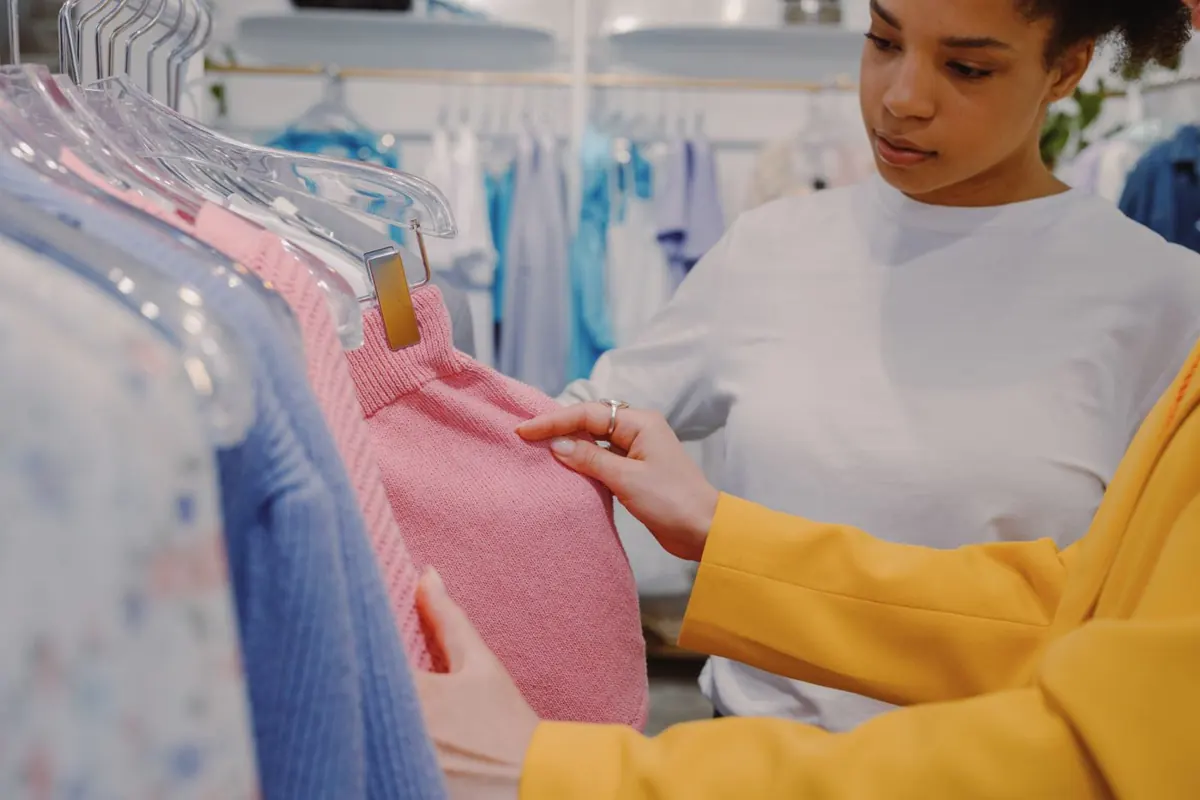
A fashion sale is worth evaluating in terms of what you would actually wear, how the item is made, and what it will cost you after the discount is forgotten. The reduced price is the least useful piece of information on the tag. The practical test is simple: before you buy, check whether the item fills a gap in your wardrobe, whether its construction and fabric will hold up to your routine, and whether its care requirements match how you really live. Most wrong purchases during sales happen because shoppers answer the price question first and skip the other two.
Why sales produce bad buys
Discounts change the decision. A product that you would ignore at full price suddenly looks like a bargain, and the savings become the reason to buy rather than the item’s usefulness. Sale environments also compress your time. Limited stock, countdown timers and crowded racks push you to decide quickly, which is exactly when you are least likely to check fit, fabric and care.
The result is usually one of three outcomes: an item that never gets worn, an item that is worn once and then fails to hold its shape or colour, or an item that requires a level of care you are unwilling to give it. None of these outcomes is about the discount itself. They are about the evaluation that was skipped.
Start with a gap, not a price
Before looking at any individual item, write down three to five situations you dress for each week. Work, weekend errands, a commute, social events, and any activity with unusual demands such as travel or physical work all count. Then look at what you already own that serves each situation.
A sale item earns its place only if it does one of the following: fills a situation you currently dress for poorly, replaces something worn out, or adds a versatile piece that combines with several things you already have. An item that works for a situation you rarely encounter is a weak buy, however low the price.
Example (hypothetical): A shopper finds a heavily reduced wide-leg trouser. Their wardrobe already includes two pairs of dark straight-leg trousers for the office and a pair of jeans for weekends. The wide-leg style would not replace any of these, and it would require different tops to look balanced. The discount is real, but the item adds a seventh way to dress for one occasion rather than solving a problem.
Check construction before fabric marketing
Fabric names are often used loosely in product copy, so the more reliable checks happen by handling the item. Look at the seams at stress points such as underarms, the crotch of trousers, and where sleeves meet the body. Check whether buttons are sewn securely and whether buttonholes are cleanly finished. Look at hems for even stitching and at linings for smooth placement without visible puckering.
Separate construction questions from fabric questions. A well-made garment in a simple cotton can outlast a poorly made garment in a more expensive fibre. When buying online, look for detailed product photography of seams and closures, and for clear fabric descriptions that name the fibres rather than only using a marketing term.
Read the care requirements as part of the price
Care instructions are a cost, because they determine how much time, money and attention the item will demand. Care labels are the most direct source for this information. Garment care labels are the most direct source for this information. General background reading on textile care at clevercare.info covers how fibres respond to washing and drying, but it does not replace the label on the specific item.
Ask yourself honest questions before buying. Will you hand wash a delicate knit, or will it go in the machine? Do you have space to dry a garment flat? Will you pay for professional cleaning, and does the item justify that cost? A garment that requires dry cleaning every few wears is effectively more expensive than its sale tag suggests.
A step-by-step evaluation
- Name the gap. Identify the situation the item would serve and the existing piece it would replace or complement.
- Try it on with the intended layers. Test with the shoes, underlayers or bags you would actually wear.
- Inspect construction. Check seams, closures, hems and lining as described above.
- Read the care label. Decide whether the care routine fits your habits and budget.
- Estimate wears. Count realistic occasions over the next month. If you cannot name at least three, reconsider.
- Set a return plan. Know the return window and conditions before paying, especially for sale items, which are sometimes final sale.
Comparing the costs
| Factor | What to check | Common trade-off |
|---|---|---|
| Wardrobe fit | Does it complete outfits you already wear? | Novelty items may be fun but rarely get worn |
| Construction | Seams, closures, hems and lining quality | Better construction may mean fewer colour options |
| Fabric behaviour | How the fibre handles wear, washing and drying | Natural fibres may need more careful handling |
| Care demands | Washing, drying, ironing or professional cleaning | Low-maintenance fabrics may feel less special |
| Return terms | Window, condition rules and final-sale status | Sale items are sometimes harder to return |
Common mistakes
- Buying for an imagined lifestyle. A dress for weekly galas is a poor purchase if your calendar has none.
- Ignoring the second-largest cost. Dry cleaning, special detergents and tailoring add up across a garment’s life.
- Trusting a single photo. Colour and drape vary with lighting and screen settings.
- Buying three of one item because it is cheap. Quantity does not fix a weak fit or a wardrobe mismatch.
- Overlooking the return conditions. Discovering that an item is final sale after a poor fit is an avoidable loss.
Limitations of this approach
This method reduces regret but cannot guarantee satisfaction. Body shape, personal taste and changing needs all affect how an item performs over time. Some good purchases will still go unworn if your circumstances change. The aim is to make the decision with the information that is reliably available: the item’s fit on your body, its construction, its care demands, and its role in your existing wardrobe.
Where information is thin, prefer the purchase with the clearest return terms and the most transparent product details. Uncertainty about a sale item is a signal to pause, not to buy and hope.
Questions to ask before checkout
- Which two existing items will this combine with?
- Can I name three occasions in the next month where I would wear it?
- Am I willing to follow the care label every time?
- What are the return terms if the fit or quality disappoints?
Related resources
Cover: Pexels photograph, used as an editorial illustration. Stock models and products shown do not imply endorsement or independent product testing. Image license.