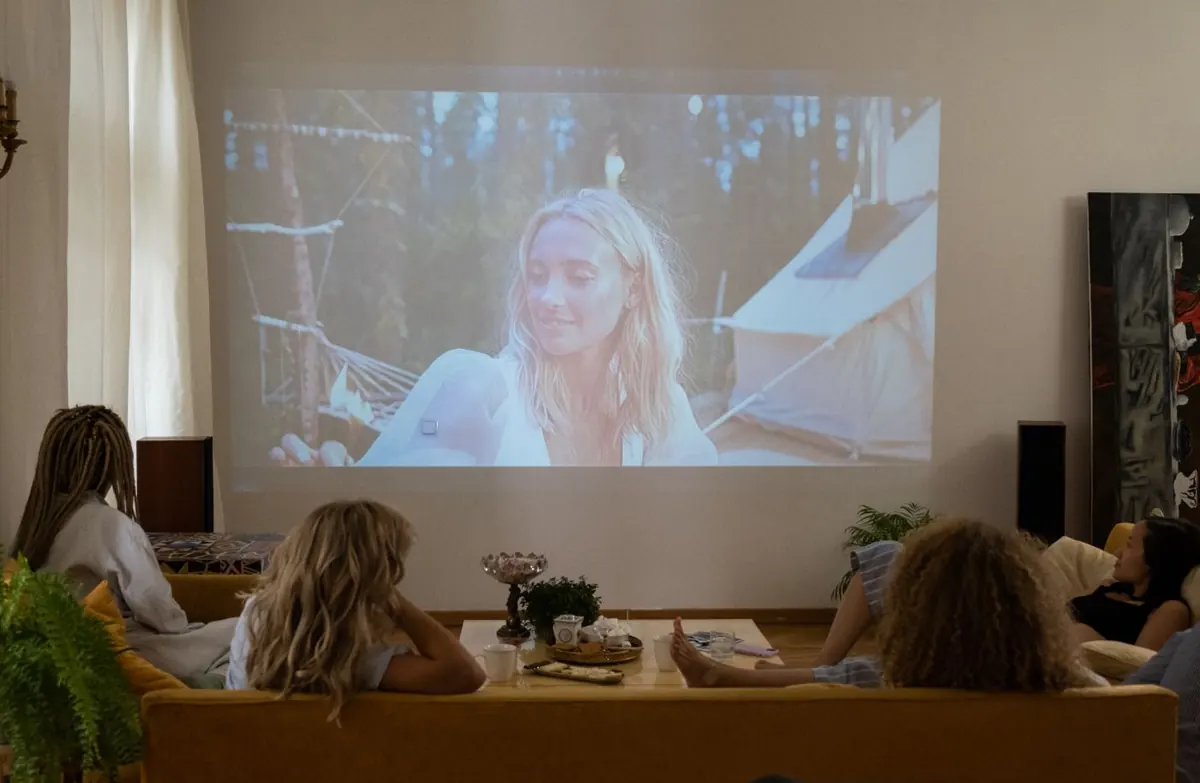
Why a themed film night works better than a random watchlist
A home film night often fails for a simple reason: nobody agrees on what to watch, so the evening becomes twenty minutes of scrolling and one film that half the room half-watches. A theme solves the decision problem. Once everyone knows the question the evening is answering, choosing films becomes a matter of fit rather than taste battles, and the conversation afterward has something to hold onto.
This article walks through a practical method for building a themed evening from start to finish: choosing a theme that is narrow enough to be useful but wide enough to yield three or four films, sequencing those films, preparing the room, and running the discussion without turning it into a seminar. The method works for two people on a Tuesday or a group of eight on a Saturday, though the details shift with the size of the room.
Step one: choose a theme that asks a question
The most common mistake is picking a topic that is really just a genre label. “Horror” or “French cinema” gives you too many options and no reason to prefer one film over another. A better theme asks a question that the films can answer differently. Compare these pairs:
- Weak: “Films set in cities.” Strong: “Does the city protect people or isolate them?”
- Weak: “Sports movies.” Strong: “What does a comeback cost the person making it?”
- Weak: “Old films.” Strong: “How do films from different decades imagine the future?”
The question should be something you genuinely would not settle by watching one film. If you can answer it after the first title, the theme is too narrow or too obvious. Write the question on a card. It becomes the anchor for everything that follows.
Step two: build a shortlist of three to five titles
For each film you consider, write one sentence describing how it bears on your question. Discard any title where you cannot write that sentence without stretching. Then check three practical constraints:
| Constraint | What to check | Why it matters |
|---|---|---|
| Runtime | Total minutes for the whole program | Two long films in one night often exhaust people before the discussion |
| Content | Whether anyone in the group needs advance warning about violence, language or themes | Surprise can derail the mood faster than a bad film |
| Availability | Whether you can legally access each title on your device or service | Scrambling for a stream mid-evening wastes the first half hour |
Settle on an order of two or three films. Three is the upper limit for most homes; beyond that, attention thins and the last film gets the leftovers of everyone’s concentration.
Step three: sequence the films deliberately
Sequencing is where a themed night becomes more than a list. Consider three common arrangements:
- Contrast: Open with the film that answers your question most conventionally, then follow with one that complicates it. Viewers feel the argument shift.
- Escalation: Order by intensity or ambiguity, lightest first. Useful when the group is mixed in experience.
- Chronological: Arrange by release date to show how the question was asked differently over time. Works well for historical themes but can flatten if the older film is slower to watch.
Whichever you choose, leave a break of at least ten minutes between films for water, washroom visits and a single sentence of reaction. Skipping the break is the second most common mistake, because the first film’s mood carries into the second without being examined.
Illustrative example: a night on “does the city protect people?”
This is a hypothetical example, not a record of an actual event. Imagine a group of five friends who want an evening built on the question above. They shortlist four films and choose three: one that presents the city as a refuge, one that shows its anonymity as dangerous, and one that is ambiguous. They open with the refuge film, because it sets an expectation, then run the ambiguous film second, because it is the one most likely to split the room. The final film is the most bleak, placed last so the discussion ends on the question rather than on the mood of the darkest scene.
During the break, one host asks a single prompt: “Who would you trust to look after you on that street?” That prompt, not the films, generates most of the evening’s conversation. The lesson is that a good theme gives the discussion a pivot, and the host’s job is to offer one prompt per film rather than an interview.
Step four: prepare the room and the expectations
Prepare three things before guests arrive. First, a visible note or card with the theme question and the running order. Second, sound and lighting checked in advance so no one spends the first film adjusting the volume. Third, a clear sense of when the discussion happens: during breaks, or only after the last film. Telling people which applies removes the awkwardness of someone starting to talk during a tense scene.
Set one expectation explicitly: not everyone has to like every film. A themed night is about the question, and a viewer who dislikes a film still contributes a useful reaction. People who feel they must defend their enjoyment tend to talk less.
Common mistakes
- Choosing a theme so broad that every film fits and none is compared.
- Including a film nobody has seen the first half of, then discovering it is slow.
- Running more than three films, which exhausts the group.
- Letting one enthusiast dominate the discussion; a rotating question prevents this.
- Ignoring access. Confirm each film can be played before guests arrive.
Limitations
This method suits groups who want shared attention. It is less useful for a mixed household where some people want background viewing, and for very large gatherings where a discussion cannot be heard. It also assumes you can access the films legally; if a title is not available, substitute rather than improvising a workaround that creates problems later.
Questions to ask before the next evening
- Can the theme be answered differently by at least two of the films?
- Does anyone need content warnings before the first title?
- Will the discussion happen during breaks, or after the last film?
Cover: Pexels photograph, used as an editorial illustration. Stock models and products shown do not imply endorsement or independent product testing. Image license.