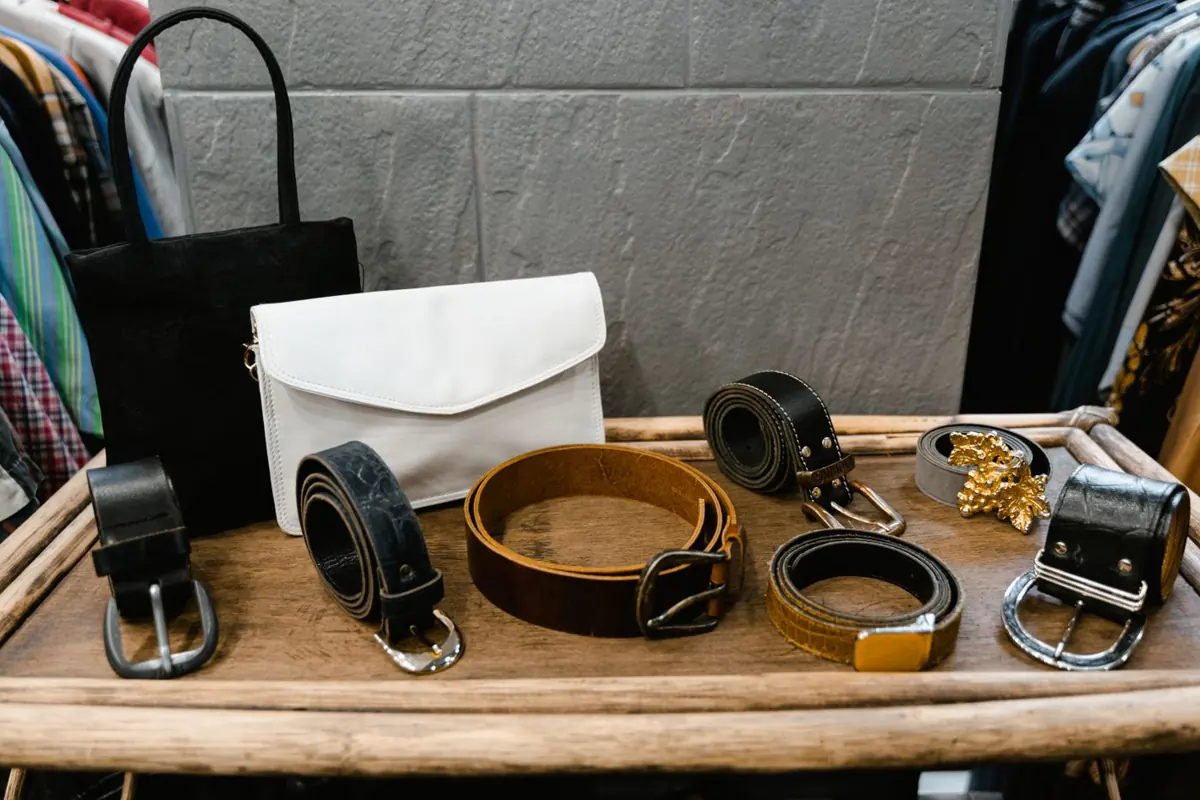
A belt should do three things at once: hold up your trousers or skirt without slipping, sit comfortably at the waist, and look like it belongs with the rest of what you wear. Most belt problems come from one of these three failing. The belt is too wide for the loops, the buckle is out of proportion, the length leaves an awkward tail, or the leather is too stiff to bend where your body bends. This guide walks through how to check each of these before you buy, using measurements you can take at home and a set of simple wardrobe tests.
What problem are you actually solving?
Readers usually arrive at belt shopping with one of four problems: a belt they own no longer works with new trousers, a pair of trousers has loops that a belt does not fit comfortably, they want a single belt that suits both work and weekend clothes, or they bought a belt online that looked right in photos and felt wrong in person. Each of these has a different fix. A belt that is too wide for your loops is a width problem. A belt that feels bulky under a shirt is often a buckle problem. A belt that looks out of place with a knit or a dress is usually a finish or colour problem rather than a size problem.
Separating these early saves time. Before looking at any belt, decide which of your garments it has to work with most often. For many people that is one pair of jeans and one pair of tailored trousers, and those two garments set most of the constraints.
Measure the loops, not just your waist
Belt length is usually sold by waist measurement, but the more useful measurement is the loop width on the trousers you wear most. Belt loops vary in width, and a belt wider than the loop will either not pass through or will sit flattened and creased. Use a ruler or a folded strip of paper to measure the inside width of one loop, and note it.
- Measure the inside width of a belt loop on your most-worn trousers.
- Measure your natural waist or the position where you normally wear a belt.
- Note where the belt will sit on you: at the natural waist, or lower on the hips.
- Choose a belt width that fits comfortably inside the loop with a little room to spare.
For example, suppose your jeans have loops that measure about 4 millimetres inside. A belt that is 3.5 millimetres thick at the strap will move freely. A belt that is closer to the loop width will need to be threaded with effort, and every time you adjust it the leather will stretch or crease. This is a practical limit rather than a style preference, and it applies regardless of brand.
Width: matching the belt to the garment
Width is partly about the loop and partly about proportion. A narrow belt on a wide-legged, high-waisted trouser can look thin and underpowered. A wide belt on a slim, low-rise trouser can overwhelm the silhouette. Neither is wrong in every case, but both are common mistakes.
| Garment | Typical loop situation | Width approach | Trade-off |
|---|---|---|---|
| Jeans | Often wider, sturdier loops | Medium to wider strap works well | Very wide belts can look heavy on slim fits |
| Tailored trousers | Often narrower loops | Narrower strap keeps the line clean | Narrow belts can feel flimsy with heavy fabric |
| Dresses or skirts | Sometimes no loops, or decorative loops | Fit depends on the waistline seam | Belts may need to sit above or below the seam |
| Coats or knitwear belts | Tied or threaded through fabric | Soft, flexible material is often better | Stiff leather may bunch fabric at the waist |
Width also interacts with how much of the strap shows. Most belts are cut to a length that leaves a tail after the buckle. If the tail is very long, a wider belt will look more deliberate, while a narrow belt with a long tail can look untidy. Trimming is possible in some cases, but it is permanent, so check the length against your usual waist position before you cut.
The buckle: scale, weight and what it does to the line
The buckle is the part of the belt that changes the overall impression most. A buckle that is too large for the strap will look disproportionate, and one that is too small can look like an afterthought. Weight matters too. A heavy metal buckle pulls the belt down and can cause the trousers to sag over time, especially on lighter fabrics. A lighter buckle is often more comfortable for everyday wear.
Check the buckle from three angles before buying: from the front, from the side where it meets your body, and from the back where the prong sits against the leather. From the side, a thick buckle adds visible bulk under a fitted shirt or knit. From the back, a sharp or poorly finished prong can press into the fabric of a shirt tucked in at the waist.
Fit and length: the steps most people skip
Belts are often sold in fixed holes or sized lengths, and the length that matches your waist may not match the hole position you prefer. A useful test is to buckle the belt at the hole you would normally use and check how much tail remains. The tail should reach roughly to the belt loop or slightly past it, without hanging so far that it drags. If the tail is too short, the belt may slip out of the buckle; if too long, it looks careless.
- Check whether the belt is adjustable or fixed-hole. Fixed holes restrict fine adjustment.
- Look at the hole spacing. Wider spacing means less precise fit around your waist.
- Flex the belt in your hands. If it resists bending at the buckle end, it may crease or crack at that point over time.
- Sit down in the trousers while wearing the belt and check whether it digs in or rides up.
Limitation: many online listings do not provide enough detail about hole spacing, leather thickness or buckle weight. If the details are missing, the safest approach is to choose a belt from a seller with a clear return policy, or to measure an existing belt that fits you well and compare.
Wardrobe compatibility: one belt or several?
A single belt can work across many outfits if it is neutral and of medium width. Colour and finish are the two factors that make a belt either versatile or limiting. A glossy black belt and a matte dark brown belt will both look appropriate with dark jeans, but they will not always match the same shoes or metal hardware. Check the belt against the hardware you already own: watches, bags, and shoe buckles.
Common mistakes include buying a belt that matches a single garment exactly, which limits its use, and buying a belt in a colour far from your shoes, which can make an outfit look disjointed. A practical rule is to keep one belt in a dark neutral for everyday use and a second belt for a different context only if you regularly wear clothes that need it.
Illustrative example: a reader owns navy chinos, grey wool trousers and a pair of black leather shoes. A medium-width dark brown belt with a matte buckle works with the navy and grey, while the shoes may not match exactly. A black belt would match the shoes but may look heavy with the lighter grey trousers. In this case, the reader might keep a black belt for formal days and a brown belt for everyday wear, and accept that not every combination is perfect.
Common mistakes to avoid
- Buying by waist size alone without checking loop width.
- Choosing a buckle that is visually heavier than the strap.
- Ignoring where the belt will actually sit, especially on low-rise trousers.
- Assuming that a belt that looks right in a photo will fit and feel the same in person.
- Forgetting that stiff leather can crease at the buckle and loosen the fit over time.
Questions to check before you buy
- Does the belt pass through the loops of the trousers I wear most often without effort?
- Does the buckle look proportionate from the front and the side?
- Will the tail be a sensible length when buckled at my usual hole?
- Does the colour work with at least two pairs of shoes I own?
Care and longevity
Belts tend to fail at the buckle end, where the leather bends most. Avoid repeatedly tightening or loosening the belt in sharp bends, and store belts loosely coiled rather than tightly folded. Leather and other materials respond differently to moisture and heat, so check any care instructions the maker provides before cleaning or conditioning. For background reading on textile and fabric care in general, the clevercare.info resource is loosely related: it covers garment care symbols and fabric-specific advice, not belts or leather accessories, so follow the maker’s own care instructions for the belt itself.
Summary
Choosing a belt is mostly a matter of matching three measurements and one judgement: the loop width, the buckle scale, the length at your usual hole, and whether the colour and finish work with the shoes and garments you own. Measure before you buy, test the fit in the trousers you wear most, and accept that no single belt will suit every outfit.
Related resources
Cover: Pexels photograph, used as an editorial illustration. Stock models and products shown do not imply endorsement or independent product testing. Image license.