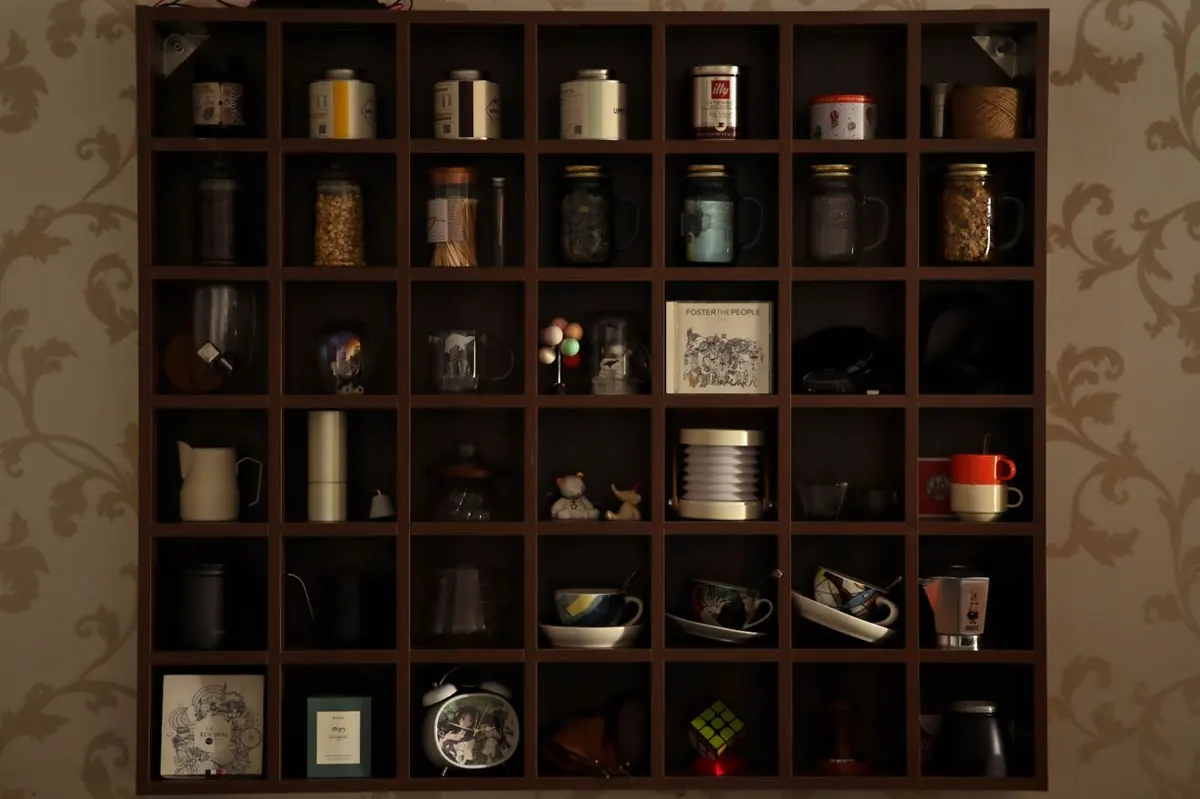
Open shelves suit items you reach for several times a day and want to see at a glance. Closed storage suits things that look untidy, need protection from dust, or should not be in plain view. Most homes need both, and the right split depends less on taste than on how often each object is used and how much visual noise you can live with. This guide gives you a method for deciding item by item, a comparison table, and the trade-offs that tend to surprise people after they install shelving or cabinets.
Why a tidy room can still look busy
Many people feel their room is cluttered even after they have put everything away. The usual cause is not the number of objects but the mix of visible and hidden storage. A wall of open shelves filled with mismatched bowls, books and jars can look more chaotic than a room with twice as many items behind doors. Yet cabinets that hide everything can make you forget what you own, and things get bought twice.
The question to answer is: which items must be visible, which must be quick to access but can stay out of sight, and which should be stored away entirely? That sorting is the real work. Choosing open or closed then follows.
Start with a reach test, not a style preference
For a week, notice where your hands go. Make a short list of items you pick up daily, several times a week, and rarely. Use three columns: frequent, occasional, seasonal or backup. Then apply these rules:
- Frequent items at waist-to-shoulder height are candidates for open shelves, provided they are either attractive or uniform enough to look intentional.
- Frequent items that are messy or varied, such as cables, sponges, sprays or half-used packets, belong in closed storage with interior organizers. Open shelving for these creates constant small disorder.
- Occasional items can go in closed storage at a reachable height. The cost of opening a door is small; the cost of finding the item among visible clutter is larger.
- Seasonal or backup items belong in high or deep closed storage, labelled on the outside.
Comparison: what each option does well and badly
| Factor | Open shelves | Closed storage |
|---|---|---|
| Access speed | Fastest; no door to open | One extra motion; faster if interiors are organized |
| Visual load | High; every item is seen | Low; the room reads as calmer |
| Dust exposure | Items collect dust and need wiping | Protected from dust and grease splatter |
| Inventory awareness | Easy to see what you have | Easy to forget contents; needs a list or labels |
| Discipline required | Constant: items must be returned to the same place | Lower daily discipline, but interiors degrade if not reset |
| Best for | Uniform, attractive, frequent items | Mixed, utilitarian, or occasional items |
A step-by-step method for a single room
- Empty one zone, not the whole room. Pick a kitchen wall, a living room unit or a hallway. Working in zones keeps the decision manageable.
- Sort by use frequency using the three columns above.
- Test visual consistency. Hold up two or three items that would sit next to each other. If their colours, heights and materials clash badly, move them behind a door or into a drawer.
- Measure the reach zone. Note the height range you can comfortably reach without a step stool. Frequent items go in that band.
- Assign the front row carefully. On open shelves, what sits at eye level is what the room will look like. Keep the front row for the items you most want to display.
- Put everything else behind doors or in drawers, and label the outside of any deep or high closed unit.
- Live with the arrangement for two weeks before changing it. Notice where you still search or where things pile up on the counter.
Worked example (hypothetical)
Imagine a small kitchen with a 90 cm open shelf above the counter. The owner’s frequent items are a kettle, two mugs, a spice rack and a bread bin. Their occasional items are a stand mixer and serving platters. Their messy items are sponges, dish soap refills and tea bags in mixed boxes.
Under this method, the mugs and spice rack become the open-shelf display because they are frequent and visually coherent. The kettle goes on the counter or in a low cupboard within reach. The mixer and platters move to a closed cupboard at mid height. The sponges, soap and tea go into a drawer with a small organizer. The shelf now looks deliberate, and the counter stays clear. This is an illustration of the reasoning, not a prescribed layout for any particular kitchen.
Common mistakes
- Using open shelves for everyday clutter. If an item has packaging, cords or varied sizes, it will look messy almost immediately.
- Ignoring dust. Open shelves near a cooker or sink collect grease and steam. Plan a wipe-down routine or move those items behind doors.
- Choosing closed storage without interior planning. A deep cupboard becomes a dead zone unless it has trays, dividers or pull-out bins.
- Forgetting what you own. Closed units hide duplicates. A simple inventory list on a card inside the door prevents repeat purchases.
- Treating the decision as permanent. You can move one or two shelves or switch a door to an open bay later, once you have observed how you actually use the space.
Limitations of this approach
The reach test works best for standard domestic storage. Rental units may not permit fixing shelves or cabinets to walls, so freestanding open units or closed boxes on castors may be the practical choice. Rooms with children may need closed storage for anything sharp, fragile or hazardous, regardless of how often it is used. Very small spaces sometimes benefit from a mix of both within one piece of furniture, such as a cabinet with glass doors, which offers partial visibility without full exposure. Finally, none of this replaces checking that a unit is firmly fixed to the wall and rated for the load you intend to place on it.
Questions to ask before you buy or install
- Which five items do I touch most often, and where are they now?
- Would I be comfortable if this item were permanently visible from the sofa or the doorway?
- Will this area collect steam, grease or dust, and can I clean it easily?
- If I put this item behind a door, will I still remember it is there?
Practical care for each option
Open shelves need a fixed weekly routine: dust the surfaces, return items to their marked positions and rotate anything that has faded in strong light. Closed storage needs a quarterly reset of interiors: empty a drawer, wipe it, check expiry dates on food or cosmetics, and re-label anything that has drifted. Both approaches fail when left unmanaged; the difference is where the failure shows up. Open shelves show it immediately. Closed storage hides it until you open the door and find the mess you have been ignoring.
Cover: Pexels photograph, used as an editorial illustration. Stock models and products shown do not imply endorsement or independent product testing. Image license.