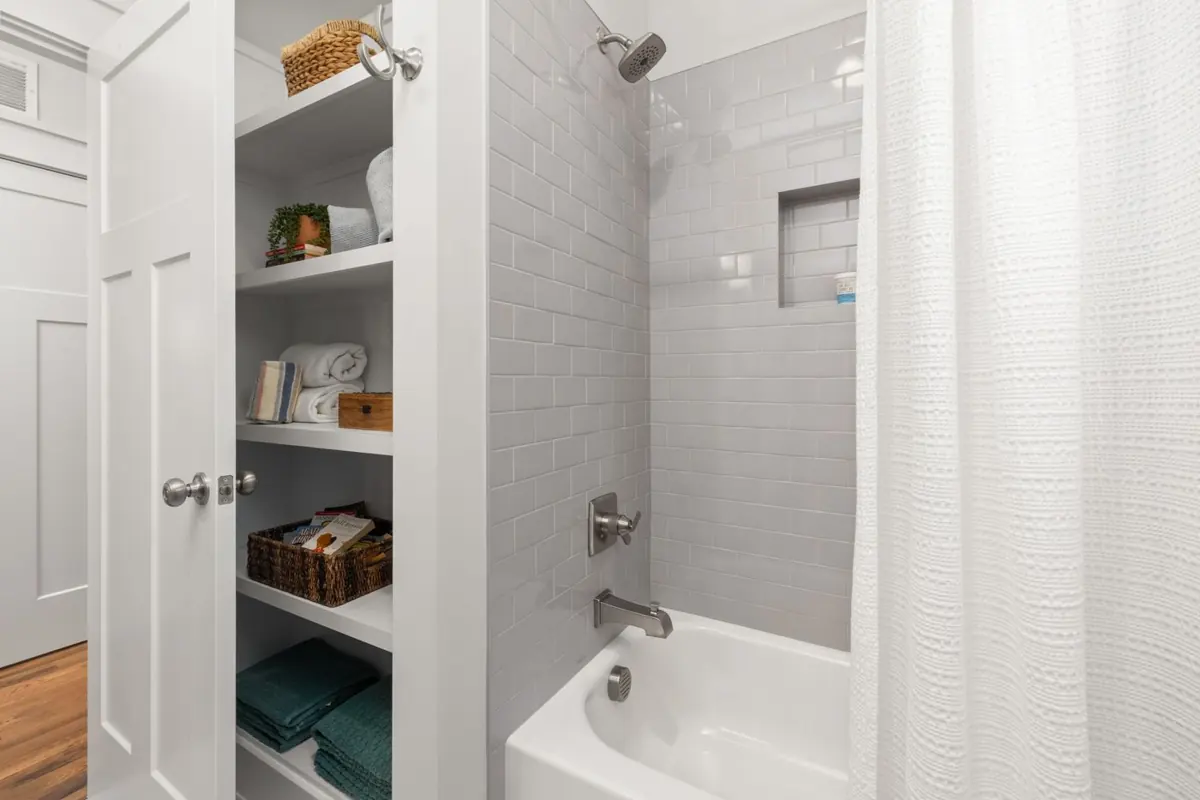
A guest-ready bathroom is less about decoration than about whether a visitor can find a hand towel, reach the sink without bumping into anything, and leave without seeing a week’s worth of clutter. The practical fix is a short sequence: clear the surfaces that collect items by default, decide where each everyday category lives, check clearances, and then test the room the way a guest would use it. This guide walks through that sequence and explains where the trade-offs sit.
What problem are you actually solving?
Most bathrooms are not badly designed. They are simply used for many things at once: personal grooming, laundry drop-off, medicine storage, cleaning supplies, and sometimes overflow from the kitchen or linen cupboard. When a guest arrives, the room shows every one of those roles at the same time. Guests most often run into one of three problems: no obvious place to put a bag or coat, surfaces too crowded to use comfortably, or a feeling that the room is never quite clean even after it has been cleaned.
Guest readiness is therefore a question of visible function. A few well-chosen storage decisions will do more than a new accent piece. The rest of this article treats the bathroom as a set of tasks rather than a set of objects.
Step one: empty the surfaces before you buy anything
Start with a clear-out that is only about surfaces: the sink edge, the tub rim, the back of the toilet, the windowsill and the top of any cabinet. Put everything from those surfaces in one basket. Then sort it into three groups:
- Used daily: toothbrush, deodorant, a hand soap. These belong within arm’s reach, ideally in a closed or semi-closed place.
- Used weekly or occasionally: hair tools, a spare razor, extra cleaning cloths. These belong in a cabinet, drawer or basket.
- Not needed: expired products, duplicates, and items you keep only because they were a gift.
A common mistake is to buy organizers before this step. You then end up with a neatly labelled tray holding things you never use, and the surface problem remains. Clearing first tells you how much real storage capacity you need.
Step two: assign a home to each category
Once the surfaces are clear, decide where each category lives. The goal is one fixed location per category, so that returning an item is a reflex rather than a decision. Consider these common zones:
| Category | Best location | Trade-off |
|---|---|---|
| Daily grooming | Closed cabinet or drawer at sink height | Hidden, so you must remember what is inside |
| Spare towels and linens | Shelf or cupboard away from the shower | Less convenient if you need them mid-shower |
| Medicines | Cabinet with a door, higher than child reach | Harder to see expiry dates in a crowded space |
| Cleaning supplies | Lower cabinet or closed bin | Can attract clutter if not contained |
| Guest hand towels | Hook or rail near the sink, on show | Shows wear faster than stored towels |
Open storage is useful for things guests should see and use, such as a hand towel and a soap dispenser. Closed storage suits anything that is personal, unsightly or easily scattered. Neither is automatically better; the question is what the room needs to show.
Example: a small shared bathroom
Consider a hypothetical example: a shared bathroom with one sink, a narrow cabinet and a shower curtain rail. The occupants keep six bottles on the tub edge, two baskets of toiletries on the floor and towels folded on the toilet lid. A workable reset might keep the two most-used bottles at the sink, move the rest into a closed cabinet, place a single bin for cleaning items on the floor beside the cabinet, and hang one clean hand towel on a hook beside the sink. Nothing new is bought, but the room now has a clear path to the sink and a visible, usable towel for a guest.
Step three: check clearances and reach
Storage that is technically present but awkward to use will be ignored. Before finalizing layout, test the room physically. Stand at the sink and check whether you can open the cabinet door fully without hitting the toilet or door. Sit on the toilet and see whether the towel rail or a shelf sits in your line of sight or within easy reach of your hand. Check whether the bath mat can lie flat without blocking the door swing.
Limitations apply. Some bathrooms have very little floor space, and the only realistic storage is above head height or inside the vanity. In those cases, prioritize closed containers on shelves at a height you can reach without stretching, and avoid placing heavy items above the sink where a fall would be hazardous.
Step four: make the room visually calm without staging it
Guest readiness does not require a showroom look. It requires consistency. Group similar items together so the eye reads them as one unit: all bottles in one cabinet, all cleaning items in one bin, all towels on one shelf. Use the same colour or material for containers where possible, but do not buy a matching set unless it fits your budget and space. Mixed containers that are arranged in rows often look tidier than an expensive set crammed into the wrong place.
Labels can help in shared homes, especially for medicines or cleaning products whose contents should not be mistaken. Keep labels plain and legible.
Common mistakes to avoid
- Buying storage before sorting. You will overfill it with things you do not need.
- Using decorative baskets as deep storage. Items disappear at the bottom and the basket becomes a dumping ground.
- Leaving the bath mat wet on the floor. It makes even a tidy room feel dirty.
- Hanging too many towels. Overloaded rails sag and look cluttered. One clean guest towel and one in use per person is often enough on display.
- Ignoring the back of the door. A simple hook there can hold a dressing gown or a bag without taking floor space.
A monthly check to keep the room ready
Guest readiness decays quickly. Once a month, repeat the surface clear-out, check for expired products, refresh the guest towel, and wipe the sink and tap. Ten minutes is usually enough if the zones are already assigned. Keep a small box for items that belong elsewhere, such as stray tissues or hair ties, and move them out at the end of the week.
Care notes for towels on display
Cover: Pexels photograph, used as an editorial illustration. Stock models and products shown do not imply endorsement or independent product testing. Image license.